Training as an IT specialist for system administration: mid-term review by our trainee
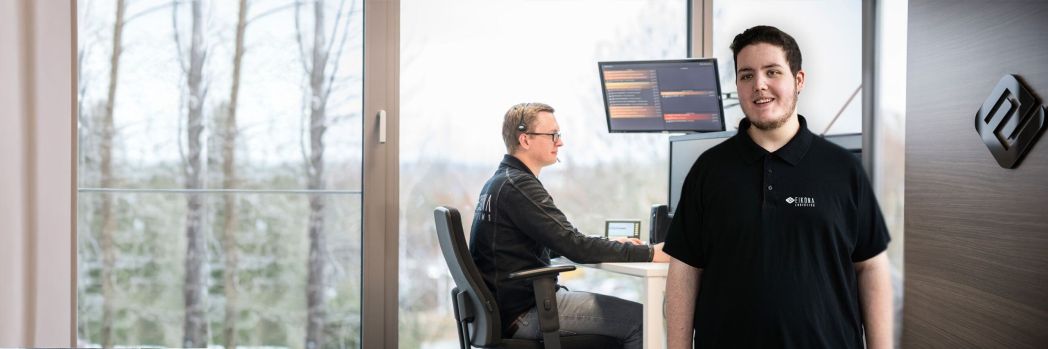
It’s December, Christmas is just around the corner, and for some, this is the perfect time to look back on the past year. That's pretty much what we did – with our trainee Noel Ravera! We were curious: what motivated him to train as an IT specialist in system integration, how was his first (full) year of training, and what does he enjoy most about his job? Read the answers here.
Career or calling? The right job in computer science
Born in Heidenfeld, Noel knew as early as seventh grade that computer science was his thing! He was already practicing programming languages at the age of 13. He was able to discuss many topics with his grandfather, who was a computer science teacher. At school, Noel Ravera was often the first port of call when ‘the technology wasn't working again’: whether it was a hardware, software or operating problem, he could help.
After graduating from high school, he had to make a decision: which field of computer science should he pursue? The choices were a degree in computer science or training in system integration or application development. Since the 21-year-old always preferred practice to theory, studying was soon out of the question. The decisive factor in the end was that he particularly enjoys working with hardware – which plays a less important role in application development.
On 1 September 2024, the time had come: Noel Ravera started his apprenticeship as a computer science specialist for system integration at EIKONA Logistics. The programme lasts three years, during which the practical phases at the company are interrupted by two-week blocks at vocational school. He spent the first year in first-level support, and now Noel Ravera is working in second-level support until the end of his training. We will come back to what exactly that means and what tasks are involved in a moment.
What does a typical working day look like?
There are no such things as “typical” working days – and that's one of the great advantages of the job, says Noel Ravera. Today, the IT specialists are installing servers in a hospital; tomorrow, they’ll be visiting a major logistics customer to reconfigure the access points; the day after tomorrow, they’ll be spending the day in the office – variety is the rule here. If the day starts at the office in Volkach, Noel Ravera arrives between 7:30 and 8:00 a.m. – he is usually the first one in the office. He starts up all the programmes he needs for the day and logs onto the service hotline, which is reserved for particularly urgent issues and is always staffed by several employees and trainees. Then he takes a look at the ticket history: did anything new come in late in the evening or even overnight? Is there a malfunction in a network or a specific system? One by one, the tickets recorded via the AutoTask tool are then processed by the entire team. Mondays in particular are very busy in ticketing. The dashboard, which monitors the various servers and displays any problems, is always in Noel Ravera's field of vision.
Even when things are quiet in the office, there’s no chance of boredom setting in: employees can use the EIKONA Academy to learn more about topics that interest them through internal training courses. There is also always a colleague in need of a hand. That's why Noel Ravera enjoys working in the office so much: “Modern working is the norm for us, which means we have a flextime model and, unless we have a customer visit, we can also work from home because everything runs via VPN. But I prefer being in the office because there's more variety there and I can see what topics the others are currently working on. If I get stuck myself, I just go to the next desk and get support from my colleagues.”
What tasks does a system administrator encounter in their day-to-day work?
Of course, despite all the variety, there are also recurring tasks in the field of system integration. In September, for example, many people start a new job, including most trainees. For the IT specialists in the system administration team, this means creating new users, preparing laptops for customers or occasionally installing a programme via Teamviewer.
In general, Noel Ravera was already able to process most tickets himself during his first year of training in first-level support and quickly help with login problems, programme bugs, etc. Sometimes, issues have to be passed on to the development team or second-level support, for example when it comes to server setup or a more complex problem that cannot be solved in half an hour. Noel Ravera is particularly looking forward to learning more about these use cases in the remaining two years of his training.
Conclusion after a full year: How do you like the training programme?
“The training programme is exactly as I imagined it would be,” reports Noel Ravera. “I can delve into many topics that interest me and even teach myself something new. What’s more, our field of work is very broad: we take on very different tasks every day, and every now and then there are real challenges that can only be solved as a team and after several hours of work. That's what makes it so exciting.”
Of course, there are always funny incidents from time to time. Since repair work is his absolute passion, most hardware problems end up on Noel Ravera's desk. He remembers quite well a laptop that no one could get to work; several people had already looked at it and were at a loss. But as soon as he connected the laptop to the power supply, it came back to life! This goes to show: sometimes, an IT problem can be solved very quickly.
How do I know if an apprenticeship in system integration is right for me?
Many people assume that prior knowledge of IT is essential in order to start training as a computer science specialist for system integration. Wrong! The job description is actually quite different. “You don’t have to be a math’s whizz or already know three programming languages to start the training,” explains Noel Ravera. “Programming is much more about logical thinking than maths. You should definitely enjoy solving problems and not be discouraged if the third or fourth approach doesn’t work – a high frustration tolerance is one of the most important things in this profession,” he laughs.
So, if you’re looking for a future-proof career with a high degree of practical relevance, where there are a few puzzles to solve, then system integration is the right field for you. Another plus: the open environment and the many nice colleagues.
Pure variety: as an IT specialist for system integration, you'll never get bored
Server installations, network administration, setting up virtual workstations, hardware problems, minor and major IT issues: all of this is part of the broad range of tasks performed by a system integrator. Trainees are allowed to work independently and take on responsibility from day one. In an open team where everyone helps each other out, it’s not so bad if it sometimes takes six attempts to fix a problem: teamwork makes the dream work!
Noel Ravera has come to a very positive intermediate conclusion and is looking forward to the next steps in his training. We're keeping our fingers crossed for him for his mid-term exam in February and look forward to continuing to work with him!