Line optimisation: fewer empty runs, stronger networks
Seasonal peaks, volatile demand, delivery bottlenecks, customs regulations, and so on – hardly any other sector of the economy is subject to as many uncertainties as logistics. Fluctuating volumes are therefore part of everyday life and do not make transport planning any easier. Another problem is the lack of transparency when it comes to capacities. Within a groupage network, each partner takes care of its own transport planning, looking only through its own lens. Without information on the availability of network partners, they cannot determine what combinations with other partners would be possible or whether certain detours could perhaps be avoided.
Fluctuating volumes and unclear capacities lead to empty runs
The result: not all journeys are fully loaded. The solution here is logistics software that is specifically designed to calculate the optimal distribution of volumes and transport routes – an approach often referred to as line optimisation. Even increases in occupancy in the lower single-digit percentage range lead to enormous savings. Find out how it works!
Main leg offers considerable potential for optimisation
A significant lever for efficiency lies at the heart of general cargo transport: the main leg. In many networks, the main leg has evolved over time. Routes were introduced at a certain point, aligned with shipment flows and only adjusted selectively over the years. However, changes in shipment volumes, new partners or altered relationships mean that these structures no longer fully correspond to reality. The main objectives of route optimisation are:
- better utilisation of existing capacities,
- avoidance of parallel or inefficient transport,
- reduction of empty runs and partial loads,
- and a decrease in the need for externally purchased loading metres.
It is important to create transparency in terms of volumes and capacities across all company boundaries.
Cost reduction: the advantages of route optimisation
“As many as necessary, as few as possible” – that should be the answer when asked how many lorries are needed within a network for the line haul. But how many is that exactly? A difficult question.
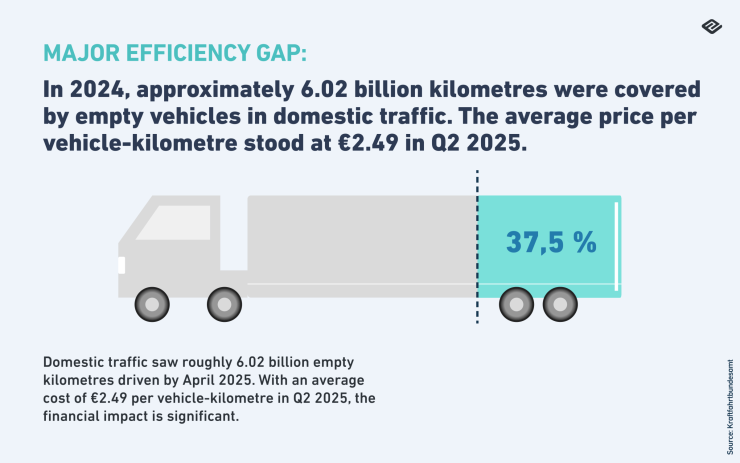
The term “avoiding empty runs” implies that empty vehicles regularly travel from A to B – the reality is, of course, quite different. A section of the route is only at 80 percent capacity, three loading metres are purchased externally, but not always used – it all adds up.
Every bit of underutilization results in huge costs. The advantage is that even small changes can often have a big impact. Thanks to route optimisation, for example, one truck can be replaced by four other vehicles in a complex ring exchange, resulting in enormous savings. The only question is: how does a network find out which trips are obsolete because the load could be carried by other trucks?
What data is missing, and how does the network obtain it?
Place all trucks and routes within a network side by side, compare them with the various destinations, and distribute the quantities so that all vehicles are optimally utilised – in itself, this sounds like a wonderful math puzzle for an algorithm. The problem is that all the necessary data is rarely available in one central location. Even if all partners are connected via a logistics platform, route planning is often still carried out using local Excel spreadsheets. However, in order for the algorithm to realistically calculate where there is potential for savings and what the optimal route distribution looks like, it needs a comprehensive data basis.
Good route optimisation software must therefore be able to collect missing data stored in local files and tables as easily as possible. After all, those responsible have little time – if data entry is complicated, the reluctance to submit it increases significantly. The interface should therefore be designed as user-friendly as possible. For example, this can be achieved with an online form that is integrated into the logistics platform. Those responsible can use it to enter information about their routes. What does the cargo space look like, are loading metres purchased externally? Is it a one-way route, a round trip or a trailer swap? The initial effort involved is somewhat higher until the data basis has been established. Once that is done, those responsible only need to adjust their entries if there has been a change in traffic.
Warning system: Attention, utilisation is off!
If the software detects that truck utilisation is not optimal for certain routes, it sounds the alarm: “The three additional loading metres purchased for this route have only been used to 20 per cent capacity in recent weeks. According to the figures, the goods could be distributed differently to save on this purchase.”
But everyone knows that the best criticism is constructive. Good route optimisation software therefore not only points out a problem but also offers solutions. The underlying calculations are complex, but the result is a clear recommendation for action. Sometimes, purchased loading metres are distributed among several trucks within the network, or perhaps additional stops are needed on an existing route. The changes are always gradual and easy to implement. This means that not all routes are adjusted at once, but rather that change management takes place step by step.
Optimally utilised line hauls: software and humans working hand in hand
Two wasted loading metres here, a section of the route not fully utilised there: it all adds up. Route optimisation can therefore be a major lever in terms of cost reduction. The software’s calculations enable networks to take action. This means that they no longer work with abstract percentages demonstrating transport utilisation, but with very specific recommendations that can be implemented step by step. Route changes are made gradually, which makes change management easy to handle.
However, companies should always keep one thing in mind: route optimisation can only work if employees are actively involved. In order to have a complete basis of data, all dependencies must be taken into account – and, as we know, there are quite a few when it comes to logistics networks. The real potential therefore lies in communication and cooperation within the network.