One platform for everything: how middleware harmonises logistics processes within the group

Heterogeneity is a wonderful thing in the landscape: a flower bed here, a small pond there, behind it a patch of meadow with wildflowers. However, when we talk about IT landscapes in companies, the whole thing immediately loses its charm. Companies often grow historically, and with them their IT systems and various processes. The result: a patchwork of tools, procedures and structures. Centralised data collection in one place? Not a chance. It is precisely this lack of a single source of truth (SSOT) that costs time and money. Read on to find out why a logistics platform as middleware is the right solution for corporations and why it does not require the replacement of every legacy system.
Communication problem: When systems don’t talk to each other
Lack of communication is not only a problem in personal interactions – it also affects IT systems. Without a uniform platform, data must be entered multiple times, shipment information manually consolidated, and formats laboriously adapted in order to be used in other software. This not only costs time and nerves, but also money, and drastically increases the error rate.
If, on the other hand, all information is stored centrally – whether it’s the live status of a shipment, the CO2 emissions of a transport or an invoice – and made available in real time, this makes collaboration much easier. The result: a central point of contact that digitally connects all partners across locations and national borders.
What is middleware and why does it play an important role for corporations?
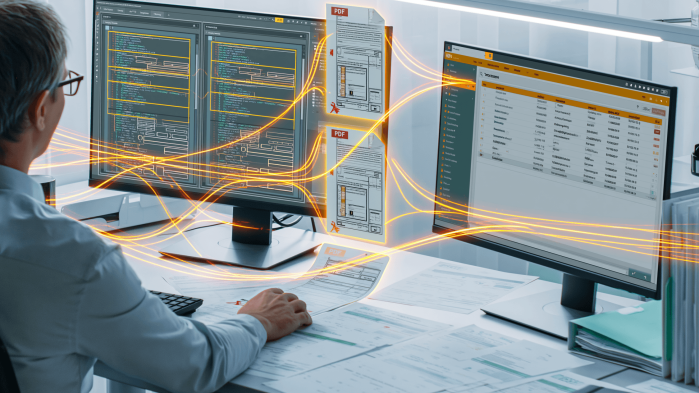
Middleware is an important part of digital transformation in companies. We can think of it as a kind of “invisible layer” between different IT systems. It acts as a central intermediary, enabling communication, data flow and process coordination between applications of different origins, even if they are based on different technologies or in different data formats. In large companies, middleware therefore fulfils the important task of connecting heterogeneous IT landscapes and creating a uniform database.
New IT platform, completely new software? Modularity is the key
If you are concerned that introducing a central database will mean replacing all your old systems, which have proven themselves in practice over many years, don’t worry. A company can integrate all its processes and service providers into a good IT platform. Some software modules may run via the platform provider itself, while others might be better connected by external service providers because they have proven themselves in practice over many years – that shouldn't be a problem.
For example, an external GPS navigation system may be in use. The information generated by this system runs via the IT platform as middleware into CO2 calculation software, which enriches the data and provides emission data for the individual shipments as a result. The task of IT service providers is to create the appropriate interfaces and connections so that the combination of different systems runs seamlessly via the middleware. Companies thus benefit from maximum modularity: they select the software on the market that best suits their processes and can add modules at any time if new requirements arise.
Industry expertise makes middleware special: expert knowledge counts
IT should always be a means to an end and never dictate processes. It's like good clothing: clothes should fit the body, not the other way around. The same applies to middleware. A good IT platform can be recognised by the fact that it is essentially “naked”, i.e. highly customisable. It is “tailor-made” to the requirements and circumstances of a corporation. After all, your operations team knows your own processes best and knows what works and what doesn’t. The task of middleware is to control these processes via a central data hub.
However, this does not mean that a mammoth project has to take decades to get the IT platform to fit perfectly. The right combination of standards that can be quickly activated and customisations that adapt them to the respective processes in the group or company makes all the difference. That is why it is particularly important to rely on an IT service provider with industry expertise. For example, if they know how general cargo processes work in logistics, what steps a shipment takes along the supply chain and what types of documents are involved in transport, this is an advantage: in the end, the middleware will not only be a perfect technical fit for the company, but also in terms of processes.
Logistics platform as middleware: the advantages at a glance
- IT fits the processes: Whether you use tried-and-tested third-party software or a proprietary solution – the platform can consolidate different data sources and formats and make them available in real time.
- Start small, expand steadily: A good logistics platform grows with you. Regardless of whether the company is growing or new areas of responsibility are being added, ready-to-use modules can be set up on the middleware, e.g. for reporting, document management or cost accounting.
- Shared database: Standardised data across all locations makes work much easier. It enables processes without media breaks and provides a reliable basis for all decisions.
- Cost efficiency and lower integration effort: Instead of developing individual interfaces for each new connection, standardised integration mechanisms of the platform serve as a basis.
- Protection for all: If all locations work independently, each one needs its own emergency system. Those who share data across the group can set up ONE business continuity management system for the platform, thus protecting all processes.
One platform, many advantages: middleware harmonises IT processes
Chaos in the IT landscape? That’s a thing of the past when companies use an IT platform as middleware. It ensures that data from ERP, TMS, reporting tools and operational applications is consistently available in real time at a central location. This harmonises all the different processes and locations. And no one has to compromise on their choice of software: long-serving programmes and proven service providers can be easily connected to a good IT platform.
Especially in the context of an increasingly globalised society, the central control of data flows is no longer a nice-to-have, but a decisive strategic advantage. Heterogeneous landscapes have their raison d’être – but rather outside in the countryside; within the corporation, it is preferable to be homogeneous.